
| Number of Volumes | 5 |
| Number of Issues | 18 |
| Number of Articles | 151 |
| Number of Contributors | 275 |
| Article View | 186180 |
| PDF Download | 102,439 |
| View Per Article | 1232.98 |
| PDF Download Per Article | 678.4 |
| -- | |
| Number of Submissions | 700 |
| Rejected Submissions | 542 |
| Rejection Rate | 77 |
| Accepted Submissions | 148 |
| Acceptance Rate | 21 |
| Time to Accept (Days) | 29 |
| Number of Indexing Databases | 10 |
| Number of Reviewers | 199 |
 |
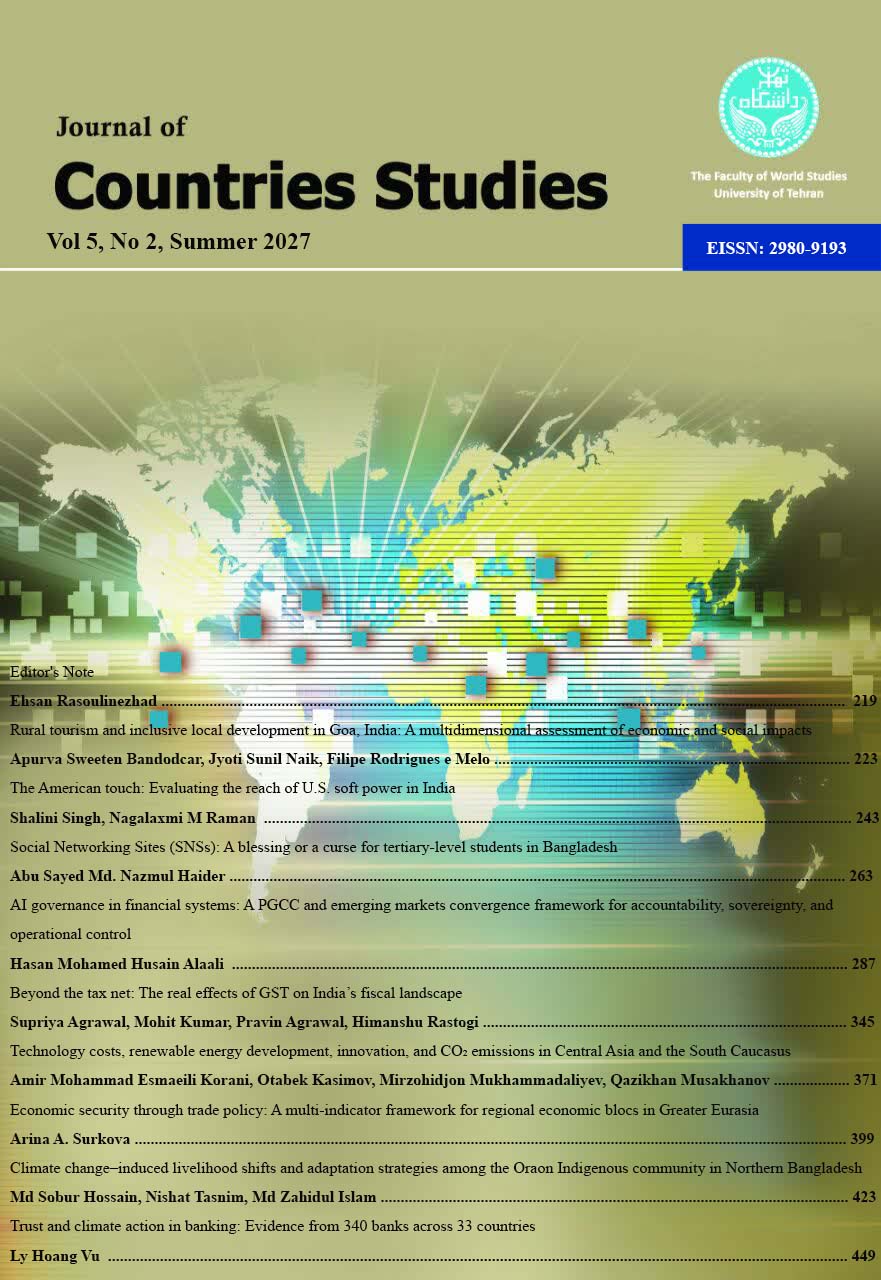
Countries Studies is published four issues a year and at the end of each season. In this journal, it is tried to examine the issues of different countries with an interdisciplinary perspective in the field of country studies.
Publication period: Quarterly (at the end of each season)
Start of publication: Spring 2023
Type of publication: Scientific-Researches
Type of accepted articles: research , review , short , case study , methodology , applied , conceptual and book review based on the authors' guide .
Areas: economics , international relations , politics , interdisciplinary and multidisciplinary studies .
Received articles format: Word
Publication format of articles: pdf
Language of publication: Farsi (at least 6000 words, and up to 30 pages in Medium octavo) with a short English abstract (150 to 350 words) and an extended English abstract (between 600 and 1000 words) along with the translation of all sources into English.
Foreign authors can submitt their full paper in English. The paper will be translated in Persian and both full papers, in English and Persian will be published.
Acceptance method: after initial review, on the basis of Double-Blind Review (neither the referees will be informed of the identity of the authors nor the authors of the identity of the referees), with at least 2 referees. The journal has the right to reject or accept and edit the articles.
In addition to refereeing, the articles will be checked with Samim Noor to confirm the originality of the article . Articles with more than 15% similarity will not be accepted.
The flow diagram of the judging and admission process is given in the article acceptance process section.
In this journal, respecting the rules of ethics in publications, compliance with the rules of the Committee on Ethics in Publication (COPE) is followed. Also, the executive regulations of the law on preventing and dealing with fraud in scientific works are followed.
Publication type: electronic ; Accepted articles on this website will be published first in the form "Articles in Press" and then, after editing and page layout, in the appropriate Vol and No.
Type of access to articles: free and open 

This work is licensed under a Creative Commons Attribution-NonCommercial 4.0 International License
The intellectual rights of the work belong to the author .
Copyright belongs to the journal of Countries Studies.
Authors are obliged to announce it in case of authoring the article using a sponsor or provider of research credit.
According to the Circular No. 40879 dated 02/24/1401 of the Ministry of Science, Research and Technology's Research Deputy, the amount of 2,000,000 Rials will be received from the authors for the initial review and refereeing, and the amount of 4,000,000 Rials will be received from the authors after the acceptance of the article , during the editing and publication stage.
All payments are made through the internet portal in the publication system.
Average initial review time: 1 week
Average review time: 8 weeks
Average editing time: 1 week
Place of publication: Tehran , Iran
Publisher: Faculty of World Studies, University of Tehran
eISSN: 2980-9193
Email: jcountst@ut.ac.ir
Last website update: September 2026
Pages 223-242
10.22059/jcountst.2026.412632.1466
Apurva Sweeten Bandodcar, Jyoti Sunil Naik, Filipe Rodrigues e Melo
Pages 243-262
10.22059/jcountst.2026.413606.1511
Shalini Singh, Nagalaxmi M Raman
Pages 263-285
10.22059/jcountst.2026.412675.1470
Abu Sayed Md. Nazmul Haider
Pages 287-344
10.22059/jcountst.2026.412773.1476
Hasan Mohamed Husain Alaali
Pages 345-369
10.22059/jcountst.2026.412638.1469
Supriya Agrawal, Mohit Kumar, Pravin Agrawal, Himanshu Rastogi
Pages 371-397
10.22059/jcountst.2026.414264.1529
Amir Mohammad Esmaeili Korani, Otabek Kasimov, Mirzohidjon Mukhammadaliyev, Qazikhan Musakhanov
Pages 399-421
10.22059/jcountst.2026.416411.1565
Arina A. Surkova
Pages 423-447
10.22059/jcountst.2026.417135.1582
Md Sobur Hossain, Nishat Tasnim, Md Zahidul Islam


